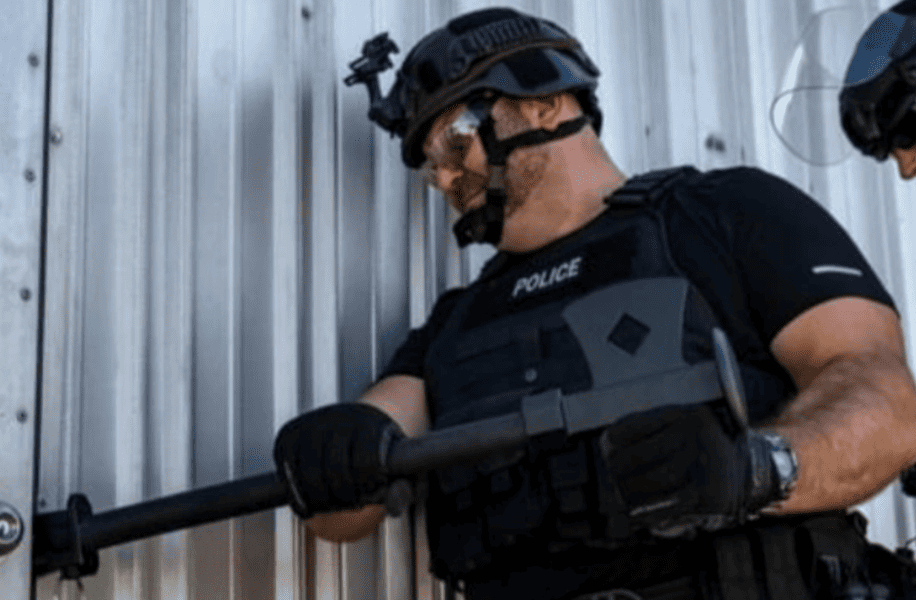
Thomas Lojek
Kurt Delia Interview:
The Raptor Rescue Tool for
Tactical and Emergency Operations
30. September 2026
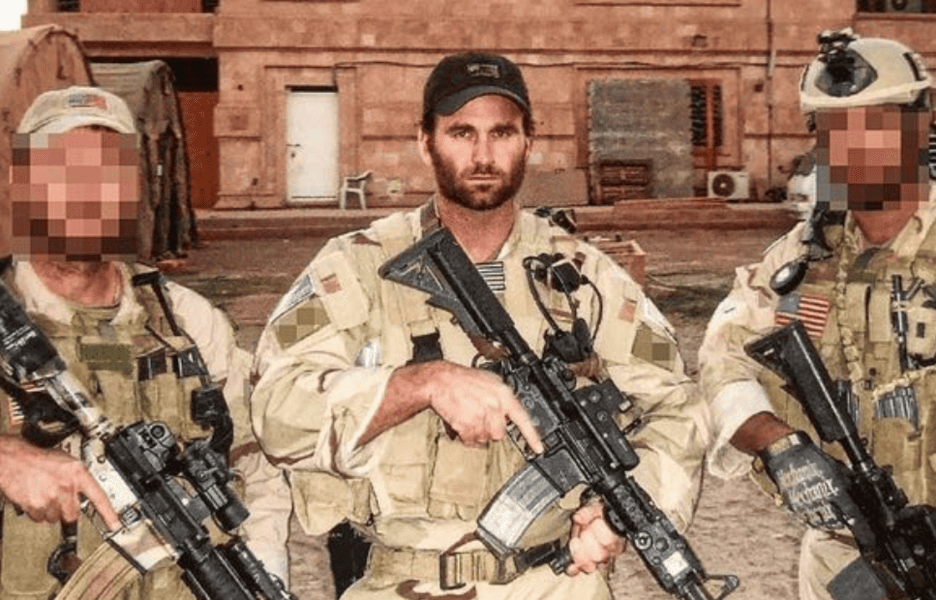
Kurt Delia is a law enforcement officer with more than 30 years of experience, an 18-year SWAT operator, multi-jurisdictional SWAT Team Commander, task force investigator, and private military contractor.
He has served as a private instructor, consultant, and SME for the U.S. Air Force 22nd Special Tactics Squadron and the U.S. Army 5th Special Forces Group in ground mobility and combatives.
He has a proven track record of adapting tactical doctrine for Foreign Internal Defense (FID) tools across high-threat international theaters in Mexico, Brazil, Central America, and Africa.
As an instructor, he delivers curriculum in mechanical, hydraulic, and ballistic tactical rescue breaching; armored vehicle (MRAP/NST) operations; immediate action skillsets; and tactical driving.
Kurt also engineers and manufactures rugged, mission-critical emergency and survival equipment, including the industry-recognized Delia Raptor breaching tool, Lifespike, and Rescuehawk.
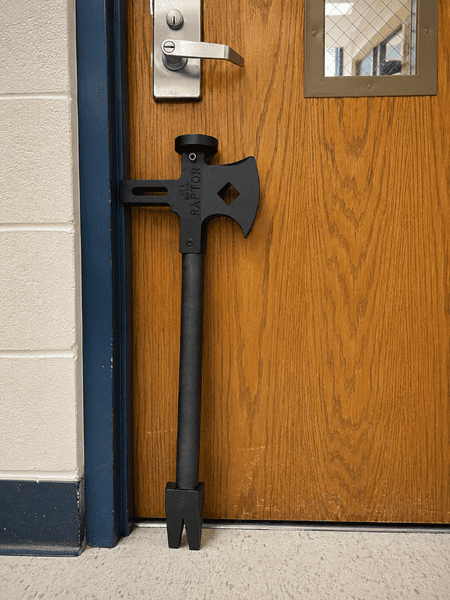
The Raptor Rescue Tool: More Than a Breaching Tool
Thomas Lojek: Why do you call the Delia Raptor Rescue Tool a “rescue tool” and not a “breaching tool”?
Kurt Delia: The Raptor tool is a rescue tool because it is a multifunctional, multi-use tool.
It can be used for many things other than just breaching.
I want you to think in terms of search and rescue, urban mount operations.
Take a look at the axe blade: it can be used for a multitude of different things—chopping trees out of the road, clearing ice-dam buildups, and urban search and rescue, including confined-space rescue and cribbing.
So you have all these different applications in one tool.
The sledgehammer was designed to punch through brick and masonry, which is why we made the one on the Raptor very, very small and narrow.
So it’s a multi-tool. It’s a rescue tool.
It doesn’t just do one thing.
It doesn’t just breach.
It works like a Swiss Army knife.
It gives you many different options during operations when you need them.
Video: Why is the Raptor a rescue tool?
The Origins of the Raptor Rescue Tool
Thomas Lojek: Was there a moment, or a specific operational experience, when you decided, “Okay, I have to sit down and design a tool for this”?
Kurt Delia: Well, I spent most of my career as a police officer and a breacher. I did a lot of breaching.
So, I remember listening to a debriefing about some officers who did not have breaching tools with them, and this is related to the Nickel Mines Amish schoolhouse shooting.
And I thought to myself, “That’s not going to be me. I’m never going to be unprepared for a breaching event where just having a simple tool could effectively save a lot of lives.”
My SWAT unit had a lot of breaching tools.
We had them in our tactical vehicle.
But as a patrol officer, we hardly had any breaching ability at all, other than your leg.
And that’s why a lot of old police officers walk with a limp—because of kicking doors over the years.
So I created the tool, the first prototype of the Raptor Rescue Tool, and fabricated it myself.
And I began using it on medical calls and at car accidents.
Eventually, people that I worked with—state troopers, deputy sheriffs, city police officers—they began to ask me about it.
And they asked me, “Do you think you could make us one, or make me one?”
And I said, “Absolutely.”
So that’s kind of the beginning, or the genesis, of the Dalia Raptor tool.
Video: The story of the Dalia Raptor tool
From Prototype to Generation Five
Thomas Lojek: And how has the Raptor Rescue Tool developed over time into what you hand out to operators today?
Kurt Delia: I had a friend of mine, Brant Kutzli, who helped me fabricate the first version of this. He’s an outstanding fabricator and welder.
We made one out of parts.
We took an axe blade and a splitting maul, and we took all these parts and put them together.
We welded it together, and it looked like an amalgamation of an ancient Viking tool, to be honest. And yes, it still does, to a degree.
After that, we refined it over time, and we began doing castings.
The first ones were fabricated and welded together using different types of steel and different components.
Now, with the Gen 5, we waterjet them.
It’s more expensive to waterjet and to do CNC machining, but it allows us to control quality and ship a product that holds true to its promise.
And we’re still alive.
Fifteen years later, we’re still producing tools and selling them globally.
At this point, we have them everywhere. We have them in the Middle East. We’ve got a couple in Europe.
They’re all over America—in hundreds of police departments.
Designing the Raptor Rescue Tool Through Operational Experience
Thomas Lojek: Can you give us a few insights into the details of the Raptor Rescue Tool and how operational experience shaped its design?
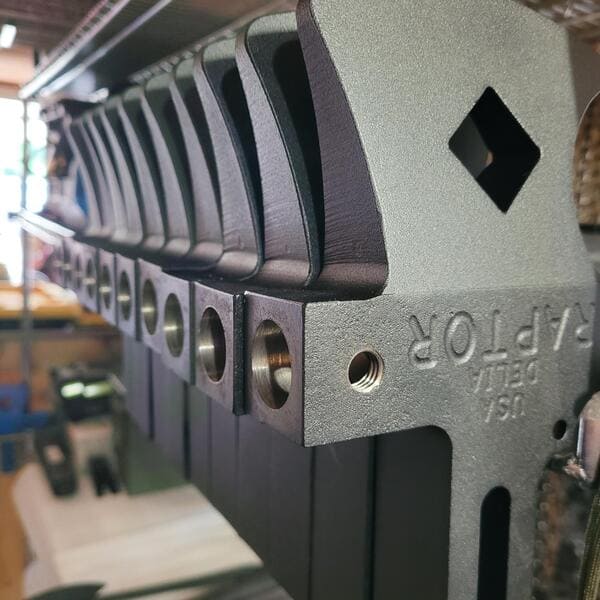
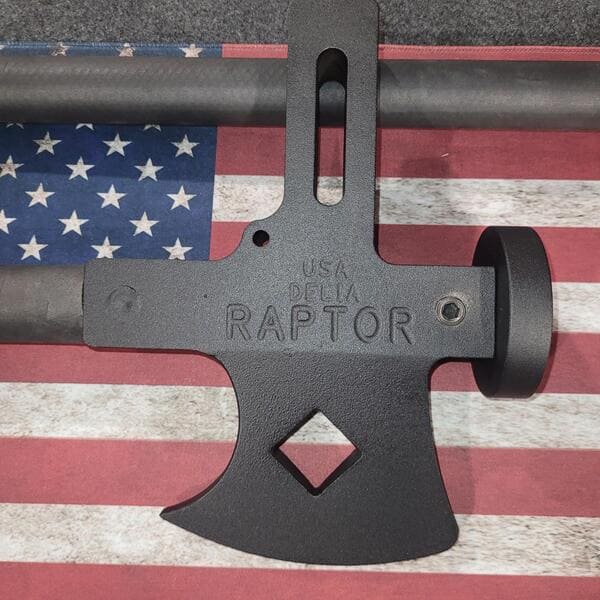
Kurt Delia: On the current version, there’s a hook on the bottom of the axe blade.
There’s a curvature there now because of an experience I had while trying to conduct a rescue and cut open a windshield to extract an elderly female who had been crushed in a rollover.
The On Patrol TV show did a special ride-along in Mount Pleasant, Michigan.
The officers carried out a rescue using the Raptor—also a windshield extrication—and I thought that hook would come in handy.
We changed the waterjet cut, and now that hook is standard on the Raptor.
The masonry hammer I told you about, for brick and cinder block, comes in very handy.
Some tactical units have actually used it to bust into concrete drug safes—with a warrant.
The ram is self-explanatory.
That is removable now.
On the Generation Five, the ram comes off, and we can put a pry end on there—a 90-degree pry—so we can insert that where the ram is.
There’s a one-inch hydrant tool for a fire hydrant.
And then there is a half-inch channel gas-line shutoff that runs the length of the masonry sledge.
In America, you can fit this onto a gas line on the exterior of a building or house and turn it off.
And at the lower end, there’s a conventional fork pry wedge.
The Raptor has a one-inch hot-rolled handle, and we rubberize it.
The Raptor has a large rubber sleeve that goes over the top of it and insulates your hands from potential electrocution.
It’s very useful when your hands get wet, if you have blood on your hands, or if you’re operating in water.
You can still maintain a good grip on that rubber.
It’s a chemically resistant and UV-resistant rubber coating that we use.
I almost electrocuted myself one time on an entry.
We had a motion-sensor light that went off and lit up our entry element.
I reached up with my Halligan bar, which I was using at the time, hooked the light, and pulled it down off the building.
I almost electrocuted myself.
So that’s why the Raptor tool has a rubber handle on it.
In the event that you happen to chop into something with power, you’re not going to electrocute yourself.
That’s the 101 on the current application of the Raptor Rescue Tool.
Video: The Raptor Rescue Tool 101